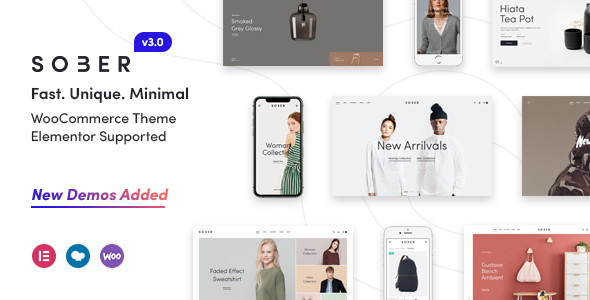
Sober is a WooCommerce-focused WordPress theme built for one purpose: help you sell products online with a clean, minimal storefront that stays out of the way of your brand.
You can use it for a wide range of shops, including digital products, hi‑tech gear, watches, men’s and women’s fashion, clothing, furniture, books, cosmetics, luxury jewelry, and accessories. The promotional material also positions it as a solid option for agencies and freelancers who need an online store as part of a broader site.
The theme runs on Bootstrap and integrates closely with Elementor and WPBakery Page Builder, so you can build and adjust layouts visually. It ships with a collection of pre-built demos, multiple product and shop layouts, and a long list of WooCommerce enhancements such as quick view, variation swatches, live search, wishlists, multi-currency, and more.
Sober targets a “Fast. Unique. Minimal.” design style, supported by regular updates, clear documentation, video tutorials, and dedicated support. If you want a focused ecommerce theme rather than a general-purpose template, it is designed with that use case in mind.
Sober leans heavily into a minimal, product-first aesthetic. The demo collection covers a wide range of styles: simple grids, full-screen sliders, lookbooks, parallax sections, category-focused homepages, and furniture-specific layouts. This variety gives you a starting point whether you sell fashion, home decor, electronics, or digital goods.
The theme offers at least 16 predefined homepages, and later promotional images mention four new homepages and new product layouts. In practice, that means you can choose a demo that is close to your ideal design and then adapt it, rather than building every page from scratch.
Because the theme uses Bootstrap components, spacing, grids, and responsiveness behave predictably. You get a consistent design language across shop, blog, and portfolio sections, which helps your store feel unified even as you mix different content types.
Product pages are central to Sober. Promotional material emphasizes multiple product page styles (up to seven layouts) along with a set of product hover effects: image sliders, large call-to-action buttons, quick view overlays, image swaps on hover, and zoom.
These options matter when you want to match your product type:
The quick view feature lets shoppers open a lightbox-style window with key details—SKU, category, tags, size and color options, price, and action buttons—without leaving the listing page. Recent updates even address a privacy issue by ensuring quick view does not expose hidden or private products, which shows attention to security.
Variation swatches via WCBoost bring color chips, size boxes, and other visual selectors to variable products. Instead of a plain dropdown, customers see clear options at a glance, which reduces friction when choosing variants.
Sober’s shop pages build on WooCommerce features but add structure and polish. You can arrange products by categories, display filters for attributes like size and color, and surface badges for new or special items. Three core shop layouts, combined with the different header and sidebar configurations, cover most store setups.
Navigation receives extra attention:
The theme’s developers recently implemented a debounce mechanism for the search function. That means search requests wait until a user stops typing, which lowers server load and improves perceived performance, especially on large catalogs.
Wishlist and add-to-cart buttons on product cards encourage quick actions from the listing pages. When combined with quick view, you create a browsing experience where customers can discover, evaluate, and add products without constant page loads.
Mobile responsiveness is a key promise in the promotional images. Sober aims for a mobile layout that feels close to a native app: clean product cards, touch-friendly buttons, smooth sliders, and navigation that collapses gracefully.
Because the theme builds on Bootstrap and is labeled “Responsive & Retina ready,” you can expect sharp images on high-density screens and layouts that adapt from large desktops down to small phones. Sticky headers, quick view, and hover effects all need to be handled carefully on touch devices; Sober’s focus on mobile presentation suggests these interactions have been tested and adapted for taps rather than only mouse hovers.
This is particularly important if your traffic comes mostly from mobile search or social media, which is common for fashion, lifestyle, and consumer product brands.
Sober gives you several layers of control:
You can start with one-click demo import, which replicates a chosen demo’s pages, menus, and basic settings. From there, you refine sections using the page builder of your choice. Because both Elementor and WPBakery are supported, you are not locked into a single workflow, which is helpful if you already know one of them well.
Unlimited color schemes and typography control give you room to match your brand without heavy custom CSS. Google Fonts support widens your font options, and blog/portfolio modules let you keep content and commerce under the same design umbrella.
Under the hood, Sober leans on WooCommerce for core ecommerce features: product management, orders, taxes, shipping, coupons, reporting, and customer accounts. The theme’s job is to expose those features clearly and add extra capabilities:
Multi-currency support is especially useful if you sell to customers in different regions. Combined with WPML and wishlist/compare plugins, this makes Sober a viable base for international stores, not just local shops.
Catalog mode allows you to disable purchasing while keeping product listings visible. This is helpful if you want to showcase products (for example, for a portfolio, wholesale catalog, or upcoming collection) without direct online checkout.
Promotional material calls out fast ecommerce performance. While performance ultimately depends on your hosting and plugin stack, several theme choices support speed:
SEO optimization appears both in the feature list and in practical integrations such as clean HTML structure, heading hierarchy, and Google Fonts. These make it easier for search engines to understand your content and for users to read it.
The changelog shows a steady flow of updates: template refreshes, plugin updates, CSS fixes (including screen-reader-text improvements), and new tweaks such as WhatsApp sharing for products and customizable wishlist icons in the header. This matters if you want a theme that keeps pace with WordPress and WooCommerce changes rather than falling behind.
Alongside WordPress, the Sober brand includes a separate Shopify version promoted in the visuals. That doesn’t affect your WordPress site directly, but it shows the design system has been adapted to another platform. If you ever migrate from WooCommerce to Shopify, you may find familiar styling options.
Within WordPress, the supported plugin ecosystem is extensive: WooCommerce, Elementor, WPBakery, Slider Revolution, Meta Box, WCBoost extensions, WPML, Contact Form 7, YITH Wishlist, and Mailchimp. This combination covers layout, animation, custom fields, translation, forms, wishlists, comparison, and email marketing without requiring you to assemble everything from scratch.
If you are launching your first online store, Sober’s demo library and one-click import give you a clear path:
The combination of pre-built pages, visual page builders, and clear documentation keeps the learning curve manageable. Video tutorials and step-by-step instructions help if you are not used to WordPress yet.
If you already have a brand or agency, you can use Sober as your ecommerce layer while keeping content and portfolio sections under the same design:
Sticky headers, mega menus, and live search help visitors move quickly between store, blog, and portfolio, which is important for content-rich sites.
Sober’s demos explicitly target several niches:
Variation swatches, quick view, and zoom effects are especially helpful in these niches, where visual detail drives purchase decisions.
With multi-currency support and WPML compatibility, Sober can support multilingual and multi-regional stores. You can:
AJAX search with category filters, combined with debounced performance improvements, also benefits larger catalogs that serve international traffic.
The theme’s promotional page highlights live sites built with Sober, such as magnolia.tienda and papelaocubo.com.br. While each site uses its own branding, they show that the theme works in real ecommerce environments, not just in demos.
For you, this means the design system is flexible enough to adapt to different industries and audiences while keeping the same underlying structure and features.
Within the WordPress ecosystem, Sober sits in the category of dedicated WooCommerce themes with a strong visual focus and tight integration with page builders and ecommerce plugins. It competes with:
Compared with broad multipurpose themes, Sober focuses more narrowly on shopping experiences: multiple product layouts, variation swatches, live AJAX search with category filters, wishlists, quick view, and promotion-focused product cards. If your main goal is selling products rather than building many different site types, this focus can be an advantage.
On the other hand, if you only need a simple blog with occasional posts and no store, a blog-first theme like the Seventeen WordPress Theme may be enough. In that case, Sober’s advanced WooCommerce tools and shop layouts might be more than you need.
Where Sober stands out is in its balance between design, ecommerce features, and ongoing maintenance:
If you are deciding between Sober and other WooCommerce themes, you can weigh these aspects along with your specific requirements for niche demos, page builders, and plugin compatibility.
Promotional materials for Sober highlight a strong track record of customer satisfaction. The showcased testimonials emphasize:
Customers consistently rate the theme highly (with multiple 5‑star reviews) for both the visual design and the support experience. For you, that suggests you are not only buying a design but also gaining access to a support team that can help you through setup and troubleshooting.
Support is backed by:
This combination reduces the risk of getting stuck during setup or after major WordPress or WooCommerce updates.
Sober is a focused WooCommerce theme for WordPress that aims to give you a fast, minimal, and flexible storefront without overwhelming you with unrelated features. It combines:
Sober fits you best if your priority is building a serious online store—whether for fashion, furniture, tech, digital goods, or a mix—rather than a general-purpose site with a small shop attached. It works for both first-time store owners, who benefit from demos and one-click import, and more experienced users, who can take advantage of the flexible layouts and plugin ecosystem.
If you want a WooCommerce theme that stays current with WordPress, offers a clean visual style, and focuses on practical ecommerce features, Sober is a strong candidate to consider for your next store build.
We are nothing without our users ! You can help us offer even more high quality content. Please share our page !
 MAFIASHARE
Sharing is caring
MAFIASHARE
Sharing is caring